Skip to product information
1 of 1

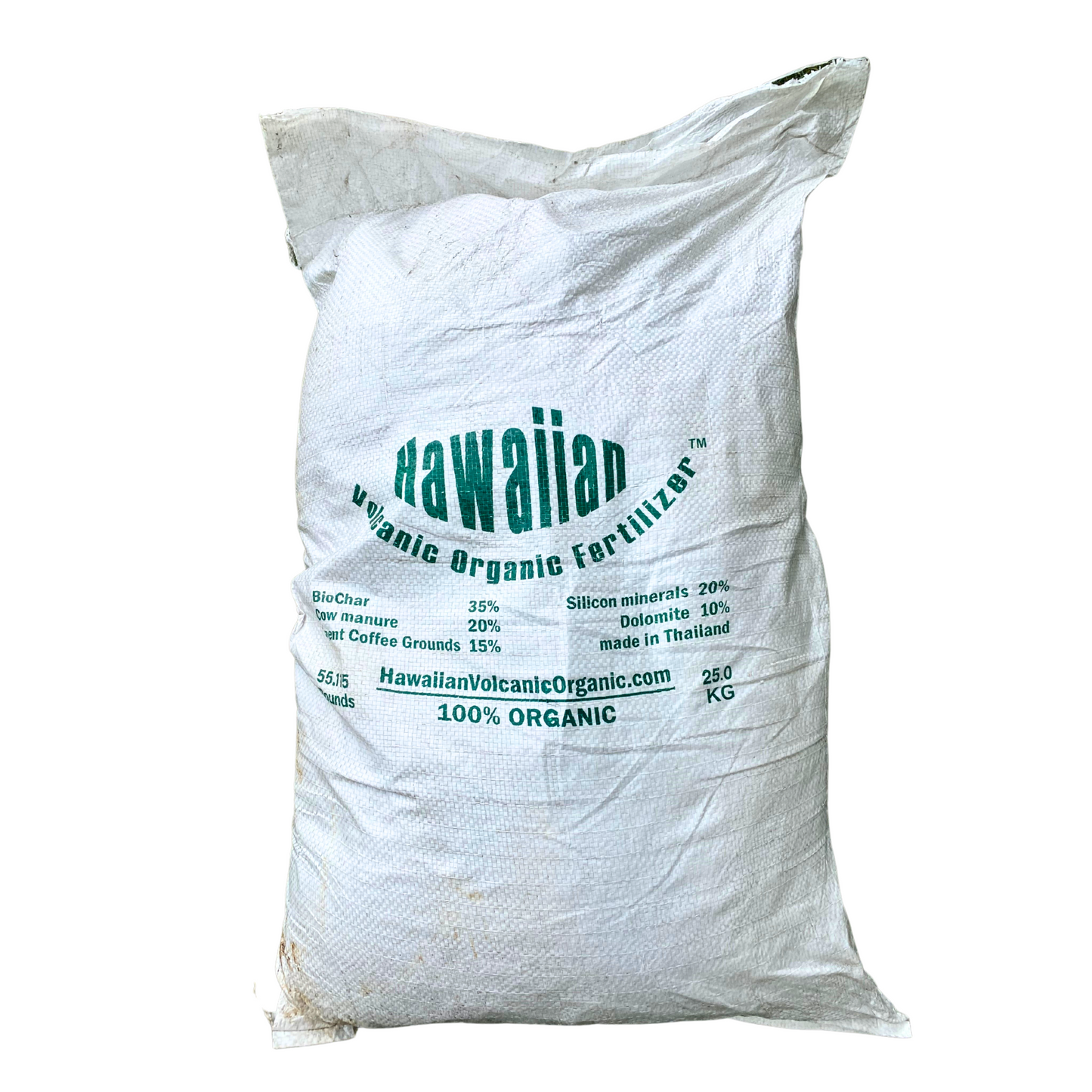
HVO Organic Fertilizer

HVO Organic Fertilizer

Regular price $49.97 USD
Regular price Sale $49.97 USD
Sale Sold out

Weight: 55.15 Pounds

Overview:

  • Biochar 35%
  • Cow manure 20%
  • Spent Coffee ground 15%
  • Silicon minerals 20%
  • Dolomite 10%
  • Made from 100% natural ingredients, no synthetic additives

The Benefits Of HVO Organic Fertilizer

A slow-release pellet blended on our farm in Mountain View for East Hawaii growing conditions. Biochar and mineral clay hold nutrients in the root zone through heavy rain, sun-dried manure and coffee grounds feed the soil over weeks instead of days, and dolomite supplies calcium and magnesium while moderating soil acidity.

Sun-Dried Cow Manure:

Our manure is sun-dried rather than composted or fermented, which keeps more of its nutrient value in the pellet. It releases slowly, improves soil structure and aeration, and supports the microbial life that turns organic matter into plant food.

Reduced Odor:

Reduced Odor Drying removes most of the odor of fresh manure, so the pellets are pleasant to handle and store.

Nutrient Concentration:

Higher Nutrient Concentration Drying removes water, so each pound of dried manure carries more nutrients than the same weight of fresh manure.

Enhanced Storage And Handling:

Easier Storage and Handling Low moisture means the material is lighter, stores well, and holds together in the bag.

Cleaner to Blend:

Cleaner to Blend Dry, uniform manure pelletizes evenly with the biochar and minerals, so every pellet carries the same blend.

Environmental Benefits:

Steadier Nutrients Dried, pelletized manure stabilizes its nutrients and releases them gradually, which reduces runoff and leaching compared with spreading fresh manure.

Results depend on your soil, your crop, and how the fertilizer is applied. If you are unsure about rates for a specific planting, call us and we will walk you through it.

Spent Coffee Ground 15%:

A source of nitrogen and organic matter that feeds soil biology as it breaks down. Coffee grounds are mildly acidic and balance the dolomite in the blend.

Silicon Minerals 20%:

Our silicon minerals are an alumino-silicate clay. In the soil, the clay helps hold nutrients in the root zone instead of letting them wash through, and it can help make phosphorus that is bound in volcanic soils more available to roots. Plants take up silicon and build it into sturdy stems and leaves.

Dolomite 10%:

Prevent acid soils. Source of calcium and magnesium.

What Is Dolomite Used For In Planting Crops?

Dolomite is a natural source of calcium and magnesium and moderates soil acidity. Here is what it does in a planting:

  1. pH Adjustment: Dolomite contains calcium carbonate and magnesium carbonate, which raise the pH of acidic soils toward the slightly acidic to neutral range most vegetables and fruit trees prefer.
  2. Calcium and Magnesium Supply: Calcium supports cell wall development, root growth, and nutrient uptake. Magnesium is central to photosynthesis and enzyme activity. Dolomite releases both slowly.
  3. Nutrient Balance: Dolomite delivers calcium and magnesium in a balanced ratio, which matters because an excess of one can limit uptake of the other.
  4. Soil Structure: Calcium helps soil particles aggregate, which improves water infiltration and root penetration.
  5. Steady Supply: A continuous supply of calcium and magnesium is what growers rely on for fruiting crops, where those two nutrients are in high demand.

At 10% of the pellet, the liming effect is mild. For acid-loving crops such as coffee, lychee, and longan, see our custom soil mixes, which are tuned to a lower pH. Use a soil test when you are adjusting pH on a larger planting.

View full details
Your cart
Product Product subtotal Quantity Price Product subtotal
hvo farm fertilizer
HVO Organic FertilizerFertilizer
$49.97/ea
$0.00
$49.97/ea $0.00

How to Use HVO Organic Fertilizer

A slow-release pellet. Work it into the soil or spread it under mulch, then water it in. Because it releases over weeks, smaller applications every 2 to 3 months work better in East Hawaii rainfall than one large dose.

  • Measure by the cup, one level cup weighs about 0.4 Lb

  • Vegetable bed

    Vegetable bed, scratch into the surface every 6 to 8 weeks

  • Fruit trees, a ring from 6 inches off the trunk to the drip line

  • A potted citrus tree with green leaves and small unripe fruits, planted in a circular bed of bark chips on a mulched ground, with other trees and palm trees in the background.

    Measure by the cup, one level cup weighs about 0.4 lb

Where to Use How Much when
New garden beds and raised beds 10 lb per 100 sq ft, about 25 cups, worked into the top 6 inches At bed preparation, before planting
Established vegetable beds 5 lb per 100 sq ft, about 12 cups, scratched into the surface Every 6 to 8 weeks during active growth
Transplants and seedlings 1/2 cup mixed into the backfill of each planting hole At planting
Containers and potting mix 1/4 to 1/2 cup per gallon of mix, blended in. 2 to 4 cups per cubic foot At potting, then 1 tablespoon per gallon monthly as a top-dress
Young fruit trees, first 2 years 1 lb, about 2 1/2 cups, in a ring from 6 inches off the trunk to just past the drip line Every 2 to 3 months
Established fruit trees 3 to 6 lb, about 8 to 15 cups, depending on tree size, spread under the canopy 3 to 4 times a year
Banana mats and papaya 3 lb per banana mat, 1 to 2 lb per papaya plant Every 2 to 3 months
Lawns and ground covers One bag per 1,000 sq ft, or 5 lb per 100 sq ft, broadcast evenly Spring and fall, or every 3 to 4 months
Bulk soil blending 20 to 40 lb per cubic yard, depending on the crop When mixing. Our custom soil mixes come pre-blended.
  • Half Rate

    Coffee, lychee, and longan: use half the rates above. The dolomite in the blend moderates soil acidity, and these crops prefer a lower pH. Our custom mixes for these crops are blended without added lime.

  • Half Rate

    Macadamia, half rate. Macadamia does best with lean feeding.

  • Full rate

    Taro, ginger, turmeric, and other heavy feeders: full rate, and keep to the side-dress schedule.

  • Measure by weight where you can; a kitchen scale is fine. One level cup of pellets weighs about 0.4 lb.

  • Keep pellets 6 inches away from trunks and stems.

  • Work them into the top few inches of soil, or spread them under mulch. Our wood chips or a cinder ring hold the pellets in place through heavy rain.

  • Water in after applying.

  • Reapply on schedule rather than doubling up. Slow release means the plant is fed over weeks, not days.

BAG COVERAGE

550 sq ft
of new garden bed prepared
1,100 sq ft
side-dressed
9 to 18
established fruit trees per application
One 55.15 lb bag prepares about 550 sq ft of new garden bed, side-dresses about 1,100 sq ft, or feeds 9 to 18 established fruit trees per application. Store the bag closed and dry.
  • soil from HVO Garden

    Soil Improvement

    Biochar is a stable form of carbon produced by the pyrolysis of organic materials, such as agricultural waste and wood chips. When added to the soil, biochar acts as a long-term carbon sink, improving soil fertility and structure. It enhances water retention, nutrient availability, and microbial activity, thus creating a favorable environment for plant growth.

  • plants

    Nutrient Retention

    Biochar has a porous structure that can absorb and retain nutrients such as nitrogen, phosphorus, and potassium, preventing them from leaching away with rainfall or irrigation water. This helps reduce nutrient loss and enhances their availability to plants over an extended period.

  • growing seed

    Soil Microbial Activity

    Biochar provides a habitat for beneficial soil microorganisms, such as bacteria and fungi. These microorganisms play a crucial role in nutrient cycling and the breakdown of organic matter. Biochar enhances microbial activity by creating stable carbon structures that provide a food source and shelter for the microorganisms, leading to improved soil health.

  • ph meter Icon

    pH Buffering

    Biochar helps buffer swings in soil pH. It acts as a buffer, preventing rapid changes in soil pH and providing a stable environment for plant roots. This is particularly useful in regions with acidic or alkaline soils, where biochar can aid in optimizing pH levels for plant growth.